
Goodbye secularism?
Not so fast.

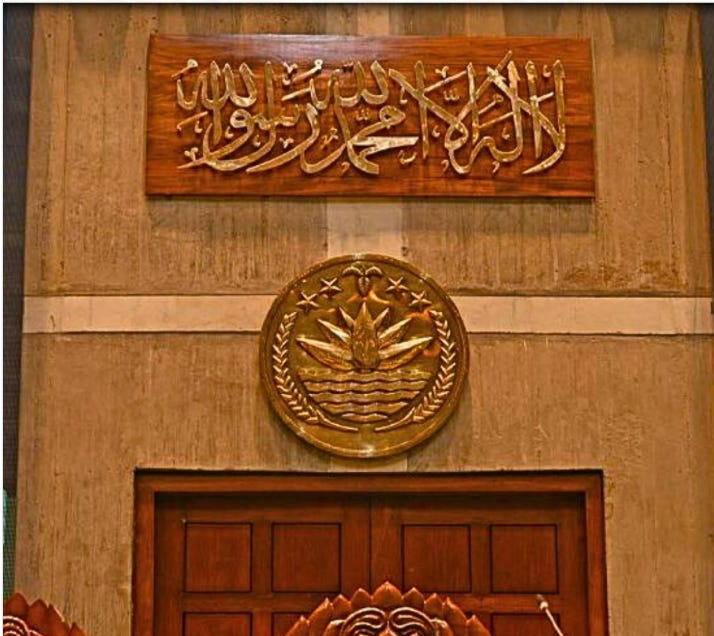
The new government in Bangladesh is decidedly turning towards an Islamic identity for the constitution. The BNP was always expected to uphold the legacy of President Ziaur Rahman, who inserted Islamic provisions into the constitution in 1977. His son, incumbent Prime Minister Tarique Rahman, has already signaled a return to President Zia’s legacy of promoting Islamic solidarity. The BNP has never accepted the use of the term ‘secularism’ in the constitutional text. This was reaffirmed by the party’s Secretary-General in a recent pre-election interview with Al Jazeera.
For those who wish to see the four fundamental Mujibist principles of ‘nationalism, democracy, secularism and socialism’ in the constitution, prepare to be disappointed. Tarique Rahman has added Arabic calligraphy to the wall of Parliament behind the Speaker’s chair, while his own office in Parliament now features a Bengali signboard with the words “absolute trust and faith in the Almighty Allah”, which were the words used to replace secularism in the preamble of the constitution in 1977. During the opening of the 13th parliament, the previous regime of Sheikh Hasina was condemned as authoritarian and fascist. The main opposition in parliament is now the Jamaat-e-Islami, which was previously in alliance with the BNP, and is committed to realizing the goal of an Islamic theocracy. With the Awami League banned and many older parties becoming extinct, many in Bangladesh wonder if Jamaat is a government-in-waiting. Jamaat, which opposed the separation of East Pakistan in 1971, has increased its vote share substantially during the 13th parliamentary election. It has cultivated links with Britain and America, which raises the haunting memory of Anglo-Saxon support for far-right groups in South Asia since the days of the colonial British Raj.[1]


The new government and parliament have enjoyed strong Western backing till now (presumably because Sheikh Hasina was antithetical to Western interests). Despite persistent human rights violations under the interim regime of Muhammad Yunus and under the current BNP government, Western capitals have turned a blind eye, and Western commentators on Bangladesh have openly supported BNP and Jamaat. In a recently published book on the history of South Asia, the historian Audrey Truschke notes that “India supported Bangladesh against American-allied Pakistan in the 1971 war”.[2] Fast forward to 2026, the United States is leading support for a role by the Jamaat in Bangladeshi politics, with the backing of BNP and much of the Bangladesh Armed Forces. It is a strange situation which raises questions about the credibility of the pro-democracy movement which ousted Sheikh Hasina. Rightwing and far-right groups now control parliament. It feels as though Bangladesh is being punished for its separation from Pakistan in 1971, regardless of the fact that the 1971 war was imposed on the helpless and destitute people of Bangladesh. Despite the anti-Hasina uprising being a youth-driven movement, there are hardly any millennials or Gen Z representatives in the 13th parliament, except for a few dynasts and newbies.
Yes, Sheikh Hasina presided over a regime which saw horrific human rights abuses. Accountability for those crimes is being pursued in a court set up by the Awami League itself. But in terms of political renewal and multiparty competition, the old habits of a single party regime continue to be felt. The 13th general election had many irregularities which were overlooked by the international community. The pre-election environment was hardly conducive for a fair vote. Civil society has become notoriously complacent and compliant with interests of the two main dynasties: the Sheikh and Zia families. Will we always play musical chairs with two families? While the Zia clan has ensured a line of succession; the presumptive heir of the Awami League is currently barred from contesting elections due to his American passport, as Bangladesh’s constitution does not allow dual citizens to hold public office.
The future of the constitution
Bangladesh’s constitution needs serious reform. The original text of 1972 is insufficient to grasp the identity of the modern state. There are competing factions, including secularists, liberals, moderate Muslim democrats, socialists, communists, and Islamic theocrats. There are a multitude of ethnic groups aside from the predominant Bengali Muslim majority. Sheikh Hasina’s government riddled the text with contradictions through the 15th amendment, which has now been overturned by the Supreme Court. One of the newly elected parties in parliament, the NCP, wants a new constitution altogether. Constitutional reform is essential for the future. A novel idea proposed by the Yunus government was to instill the idea of pluralism. Bangladesh can build on that principle in the future because most Bangladeshis do not want Laïcité-style secularism nor a fundamentalist religious theocracy.
In conversations with lawyers and academics, I found an urge to establish a middle ground. The constitution can be secular and express Muslim identity at the same time, without explicitly referring to secularism, or discriminating on a religious basis. Many have supported the ideals of the Proclamation of Independence, including equality, human dignity, and social justice.
July Charter
The interim government of Muhammad Yunus proposed a set of checks and balances, including many proposals which mirror the BNP’s 31-point agenda. These proposals were collectively listed in the July Charter. However, pro-BNP lawyers have filed lawsuits challenging the legality of the July Charter. The established political class is hesitant about opening a pandora’s box by implementing the July Charter. Will the BNP adopt cosmetic reforms or truly implement a system of checks and balances?
Economic reforms
There is hope for economic efficacy under the new BNP government. The stock markets in Dhaka and Chittagong, as well as the business community, have been exuding robust confidence. The BNP has a history of pioneering liberal market reforms in the late 1970s and early 1990s. Will Tarique Rahman reclaim that legacy which was lost during years of incompetence and corruption? The BNP has an opportunity to remove the term ‘socialism’ from the constitution and replace the term with ‘social justice’ in keeping with Islamic ideals. Will it grasp this opportunity? It can reflect a genuine commitment to the free market.
Human rights
Bangladesh’s constitution will continue to be an overwhelmingly secular constitution in paper, with a chapter devoted to fundamental rights. The July Charter also proposes to expand fundamental rights. While the preamble and Article 2A will continue to reflect Islamic nationalism, the judiciary in Bangladesh can override these provisions with the chapter on fundamental rights, which would require any religious interpretation to be in conformity with fundamental rights. There is a need for judicial activism to overturn restrictions on freedom of association, promoting evidence-based counterterrorism policy, and upholding civil liberties.
Footnotes
During the Quit India movement in the early 1940s, Hindu fascists and supremacists colluded with the British colonial government.
Audrey Truschke, India: 5000 Years of History on the Subcontinent (Princeton University Press 2023) 471.