

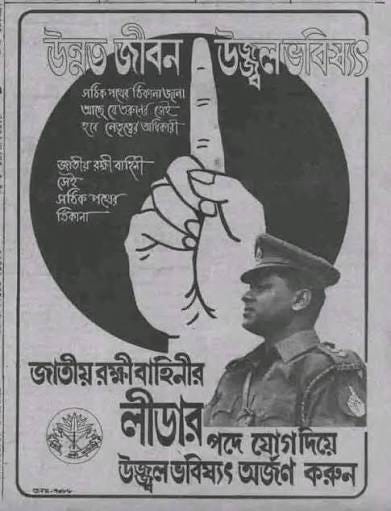
One of the most controversial aspects of Sheikh Mujib’s regime was the creation of paramilitary organizations. Socialist politicians supported the concept of a ‘national militia’, which was one of the demands of the 6-point movement in East Pakistan. On 3 January 1972, the government announced the creation of the Central Regulating Board of the National Militia. Prime Minister Tajuddin Ahmad was made the chairman. One of its members included Maulana Abdul Hamid Khan Bhashani. Moni Singh of the Communist Party of Bangladesh was also a member of the board. After Mujib became Prime Minister on 12 January, he entrusted the aid of the Indian Army to set up a national militia. Mujib ignored the board formed by Tajuddin Ahmad. Mujib also distrusted the Bangladeshi military. The Indian military agreed to establish the national militia which would be responsible for internal security. After the withdrawal of the Indian military from Bangladesh on 17 March, the Indian army officer Major General S. S. Uban was appointed as an advisor to Bangladesh regarding the structure, composition and training of the national militia.
Mujib Bahini
S. S. Uban had advised Sheikh Moni (Mujib’s nephew) on the formation of the Mujib Bahini during the Liberation War. Uban had overseen the training and operations of the Mujib Bahini, which was a component of the Bangladesh Forces in the war. The Mujib Bahini was set up by India’s external intelligence agency, the Research and Analysis Wing (R&AW). It consisted of largely Awami League and Chhatra League activists. General Uban accompanied Sheikh Moni into Bangladesh through the Chittagong Hill Tracts where the Mujib Bahini fought off Mizo rebels who took sanctuary in the jungles and were supported by the Pakistani military. Even after India’s military withdrawal from Bangladesh in March 1972, some Indian troops remained covertly in the Chittagong Hill Tracts to secure the border. The nascent Bangladeshi government requested India’s aid to fend off Mizo rebels.
Jatiya Rakkhi Bahini
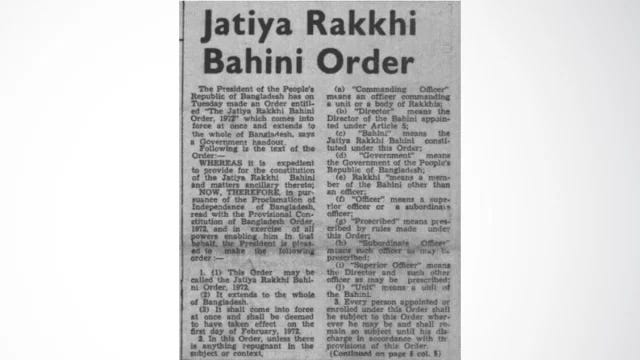
The Indians believed leftwing insurgents would seek to destabilize Bangladesh. Maoist Naxalites in West Bengal had been waging a movement against the Indian state. India deployed its Central Reserve Police (CRP) in West Bengal to counter the Naxalites. The CRP was a model for Bangladesh in establishing the Jatiya Rakkhi Bahini (JRB) as a paramilitary organization. It was formed on 1 February 1972. Brigadier General A. N. M. Nuruzzaman, who was co-accused with Mujib in the Agartala Conspiracy Case, was made its first Director-General.
By 1973, several leftwing insurgent movements had emerged in Bangladesh. These included the militant Gonobahini and East Bengal Proletariat Party (Sarbahara). The Gonobahini was the militant wing of the National Socialist Party (Jashod), which was the largest opposition party during the Mujib era. The Sarbahara was led by the Marxist revolutionary Shiraj Sikder. The JRB was deployed to quell these insurgent movements.
In 1974, a mother filed a case after her son went missing and was later found at a police station in a miserable condition with signs of physical torture on his body. The victim, Chanchal Sen, was taken away by the JRB, tortured, and later transferred to the Special Branch of Police. His detention was ruled unlawful by the Supreme Court. The JRB was given immunity from prosecution in 1974.
The JRB emerged as the paramilitary of the ruling Awami League. The JRB was used to protect AL politicians from attacks by leftwing insurgents. But the JRB’s ruthless tactics involved torture, extrajudicial killings, intimidation and sexual harassment. Its most famous victim was the Sarbahara founder Shiraj Sikder who was tortured to death by the JRB. The JRB was perceived within the Bangladeshi military as Mujib’s personal army. According to the historian S. A. Karim, “there was a great surge of feeling in the armed forces that the JRB had been created as a counter force to them. This was not so, for their functions were completely different. JRB was set up as a law enforcing agency. At no time was it issued with heavy weaponry like artillery, anti-tank guns, or anti-aircraft guns to enable it to counter the military”.
According to Human Rights Watch, the pattern of institutionalized violence in Bangladesh can be traced back to the formation of the elite paramilitary units of the JRB. The JRB was merged into the Bangladesh Army in October 1975 and its ruthless tactics were deployed to quell the insurgency in the Chittagong Hill Tracts. The JRB was described by journalist Anthony Mascarenhas as a “gang of hoodlums little different from the Nazi Brown shirts”. It was compared to the Gestapo, the secret police of Nazi Germany, by the scholar Ghulam Murshid.
Lal Bahini
The Lal Bahini (meaning “Red Army”) was the militant paramilitary wing of the Bangladesh Jatiya Sramik League, the trade union front of the ruling Awami League which operated between 1972 and 1975. The group was perceived as an unofficial socialist militia for Sheikh Mujibur Rahman’s government. Dreaded for their signature red shirts and headpieces, they were frequently deployed in the industrial hubs of Dhaka and Chittagong. The group operated outside official state channels and was accused of violently suppressing labor uprisings, clashing with left-wing political groups, extorting funds, and intimidating citizens.
Footnotes
S. A. Karim, Sheikh Mujib: Triumph and Tragedy (UPL Books 2022)
Ignoring Executions and Torture: Impunity for Bangladesh’s Security Forces (Human Rights Watch 2009)
Aruna Sen vs. Government of Bangladesh (1975) 27 DLR (HCD) 122
Md. Shamsuddin alias Lambu & Others v The State & Others 1988 8 BLD (AD) 93