

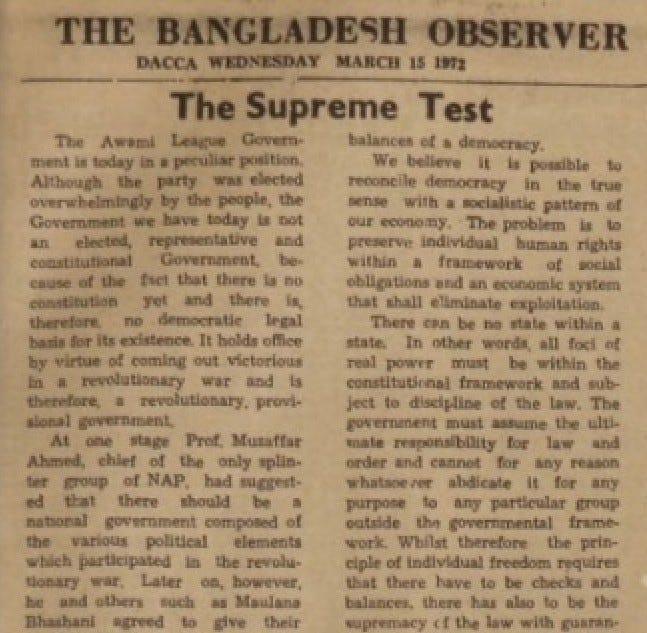
The Bangladesh Observer published a famous editorial which was critical of the government on 15 March 1972. The editorial is republished below:-
The Awami League government is today in a peculiar position. Although the party was elected overwhelmingly by the people, the government we have today is not an elected representative and constitutional government because of the fact that there is no constitution yet. There is therefore no democratic legal basis for its existence. It holds office by virtue of coming out victorious in a revolutionary war and is therefore a revolutionary provisional government.
At one stage, Professor Muzaffar Ahmed, chief of the only splinter group of NAP, had suggested that there should be a national government composed of the various political elements which participated in the revolutionary war. Later on, however, he and others such as Maulana Bhashani agreed to give their support to the government, especially for bringing about normalization in the country. The Awami League had the right to claim that they were the chosen of the people, and therefore politically they had the right to form the government; and since a constitution cannot be had overnight and conditions in the country were far from normal, it was imperative to form a government, take steps to create normal conditions, and then to call the Constituent Assembly and make the basic law of the State. It has to be admitted that conditions are not yet absolutely normal and extra legal actions have to be taken to meet the day-to-day situation. But one hopes no avoidable time will be lost in giving a legal and constitutional shape to the basic structure of our state. The people voted for the Bangabandhu, and he has said that Bangladesh will be a democracy with socialism and secularism as the guiding lights. Both he and the Awami League have been pledged to democracy for long. In fact, their fight against the then regime of Pakistan was for the restoration of democracy and fundamental human rights. Therefore, they cannot ignore these two basic requirements of a modern state. And these can be guaranteed only by a constitution and a government machinery which will contain within itself the checks and balances of a democracy.
We believe it is possible to reconcile democracy in the true sense with the socialistic pattern of our economy. The problem is to preserve individual human rights within a framework of social obligations and an economic system that shall eliminate exploitation.
There can be no state within a state. In other words, all foci of real power must be within the constitutional framework and subject to discipline of the law. The government must assume the ultimate responsibility for law and order and cannot, for any reason whatsoever, abdicate it for any purpose to any particular group outside the governmental framework. Whilst therefore, the principle of individual freedom requires that there have to be checks and balances, there has also to be the supremacy of the law with guaranteed judicial impartiality. The principle of socialism means that individual rights and privileges are subject to the overriding interests of society as a whole, and it also involves the necessity to eliminate exploitation of man by man under whatever name it may seek to exist. In making the constitution, this aspect of the problem with which we are faced today must be kept in mind.
The public services today are in a demoralized state. Many factors are responsible for this, not the least of which was the ten months of sadistic brutality and lawlessness encouraged by the then regime itself. The Awami League in power cannot do itself what it condemned in the previous regimes. The permanent services should as far as possible be left alone. Mr. Monem Khan used to issue directives straight to the village daroga. If we replace one Monem Khan by thousands of them, that will be no improvement.
Sheikh Mujib loves his people and the people love him in return. It is for him now to take on the leadership of the whole nation and put it on the road to orderly progress. He probably does not know how strong he is. His strength comes from the people and not from any particular group, clique or vested interest. In a way he is now facing the supreme test of his greatness.
The newspaper’s longstanding editor Abdus Salam was forced to quit after writing and publishing this editorial. The newspaper, which was founded in 1949, was taken over by the state in 1972 as part of the nationalization of the press. It was restored to its original private owner in 1984.
Footnotes
Banglapedia - The Bangladesh Observer
We Wish to Inform You: Censorship in Bangladesh (1972-2024) by Naeem Mohaimen (The Daily Star)